
Type in an address. CompAI pulls the sold comps, works out what the house is worth today and what it's worth fixed up, estimates repairs, and gives you a cash offer with the math on the page. Takes about 30 seconds.
We comped over 7,500 deals by hand. Then we built the software to do it the same way.
One address, start to finish, in about a minute.
Seller told me she had two other investors calling her back that afternoon. I ran the address while we were talking and gave her a number before we hung up. She signed on the call. My old way… I'd have called back the next morning and she'd have already sold to someone else.
Built for investors, by investors.
We're investors. Our team has closed over 750 deals and comped about ten times that many by hand, mostly in markets we can't drive to. When you can't drive by the house, the comps have to be right. So we took the way we comp and turned it into software.
Most tools hand you an ARV and stop there. CompAI gives you the as-is value too, and lists every sold comp it used with the address and sale price, so you can check it yourself. When there aren't enough good comps, it tells you that and holds the offer back.
Every analysis gives you both numbers. They answer different questions.
As-is is what the house sells for today, in the shape it's in. It's the number that makes sense in a seller conversation. It's what their house is worth right now, and you can show them the sold comps behind it.
As-is is also the number novation operators live on. In a novation the house goes on the market close to the shape it's in, so as-is is what it will actually sell for. That number sets the list price, the seller's net and your spread.
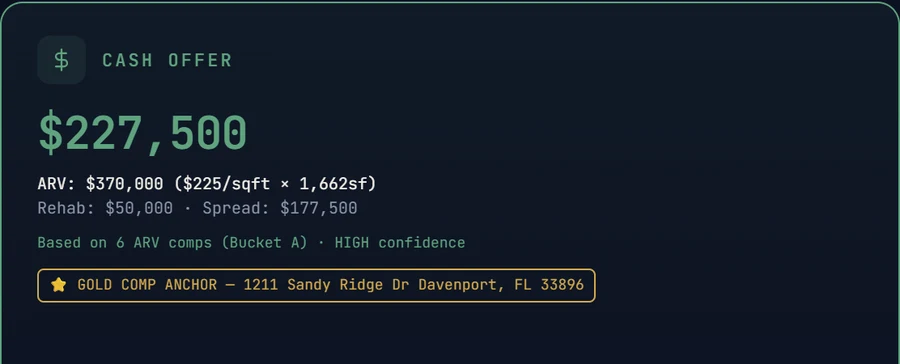
ARV is what the house sells for fixed up. That's the number your cash buyer or JV partner cares about, and it's what the cash offer is built from.
Novation offers are calculated off the as-is value. Cash offers are calculated off ARV minus repairs.
Cash offer: $370,000 ARV × 75% = $277,500, minus $50,000 repairs = $227,500.
I do a lot of novations and every other tool just gives me ARV, which is useless for that. The as-is number is what I list at. First tool I've used that gets it.
Add the condition and anything the seller told you, if you have it. CompAI pulls recent sold comps near the house from nationwide sold data.
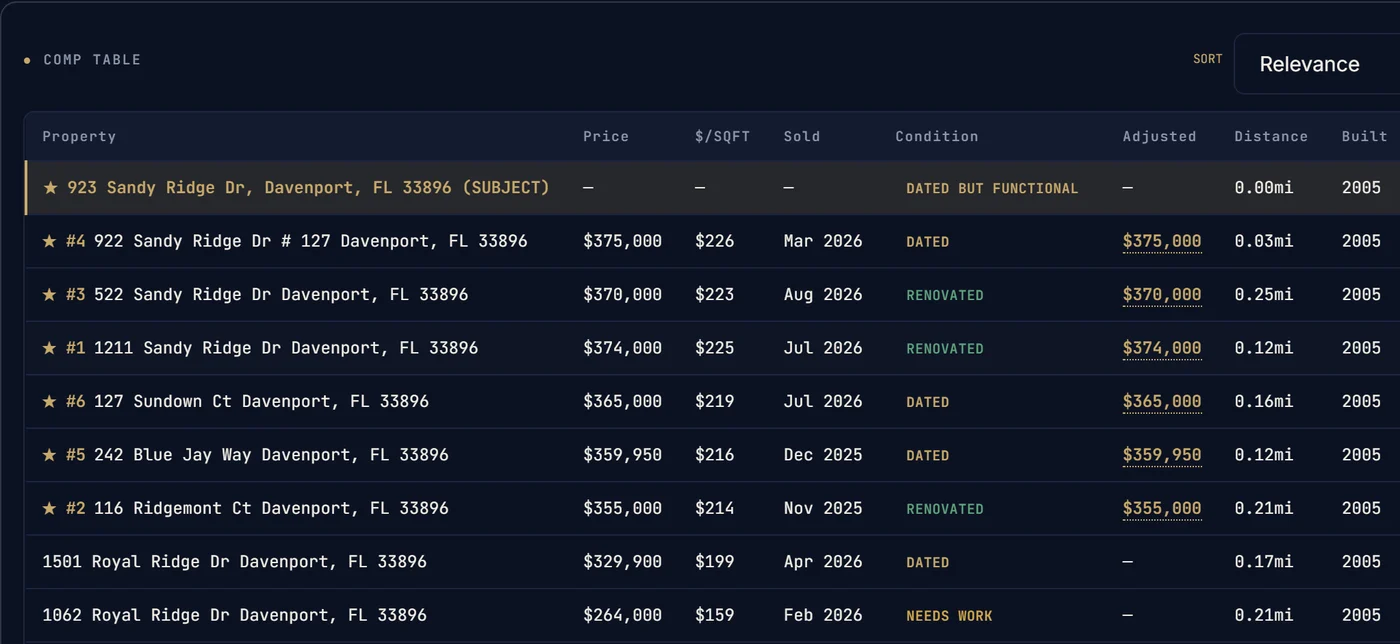
It throws out sales that weren't real arm's-length sales, and keeps the ones that match the house on size, age, beds, baths and condition. Every comp it keeps is listed with the address, sale price, price per square foot, condition and distance.
As-is value, ARV, a repair estimate and a cash offer, with the math written out under it. If the comps can't support an offer, it holds the offer back and tells you why.
Every number comes with the sold comps it came from, so you can check it before you call the seller.
As-is is what the house sells for today. ARV is what it sells for fixed up. Each comp shows the address, sale price, sale date, condition and distance.
Based on the condition of the house. It's there to price the deal. Your contractor's walkthrough still sets the budget.
The cash offer is built from ARV minus repairs, and every step is on the screen. That math is for you, your buyer and your JV partner. The seller sees the as-is value and the comps.
If the comps don't support a number, you get the reason in plain words instead of an offer.
It told me it didn't have enough comps to price a house out in the sticks. I was annoyed for a bit, then I found out a few months later what it actually sold for. Glad I didn't make that offer.
Written from the same analysis, with the address, the offer and the condition of the house.
Paste what the seller said and get a counter built from the comps. You decide what you actually say.
Open any deal you've run. Export a report to PDF, or your deal history to CSV or JSON.
Do novations? Tell us when you sign up and we'll add a novation offer to every analysis, built off the as-is value, with the seller's net and your spread shown. If you don't, you'll never see it.
Anyone pricing single-family deals, whether it's your first or your five-hundredth.
I'm newer to the business and I never fully trusted my own comps. Now I can see every house it used and the sale price, so when my hard money lender asks where the number came from I just send him the list.
We were spending 30 to 40 minutes a lead on comps across three people. Now it's under a minute and everybody's numbers match. That part matters more than the speed, honestly.
Up to 200 analyses a month. The first 7 days are free.
Or $500 a year, billed annually. The 7-day trial needs a card, and you're not charged until day 8. Cancel from your dashboard.
Start the 7-day trial →Run your first address in about 30 seconds. Free for 7 days. Card required, not charged until day 8. Cancel from your dashboard.